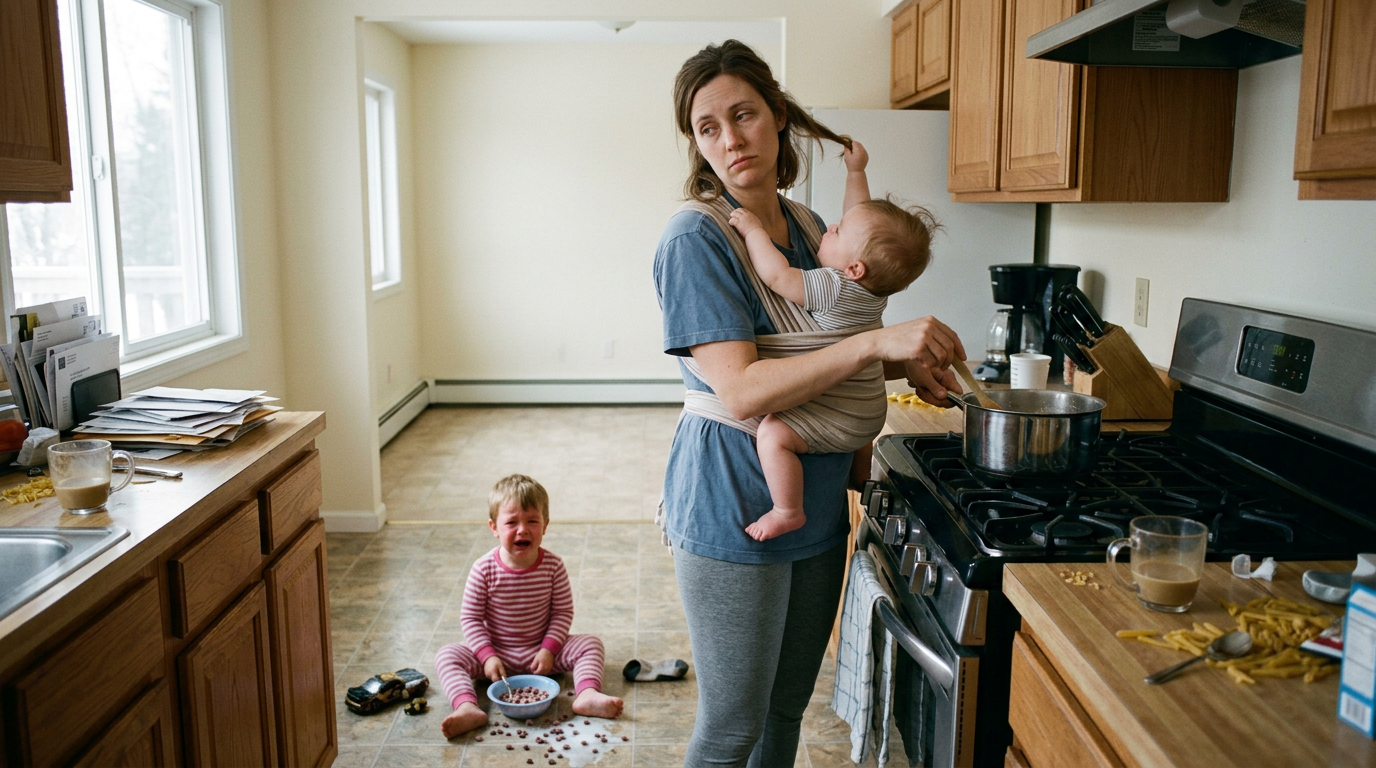
The situation
A mother is alone in a house with a nine-month-old. Her partner left for work at 7am. It is 2pm. She has not eaten. She has been the sole source of food, comfort, stimulation, protection, and regulation for seven hours. She feels desperate, then ashamed for feeling desperate. Another polished parenting image scrolls past, and the guilt deepens.
The mechanism
Humans are cooperative breedersHrdy (2009); Nesse (2019); Bowlby (1969).. Caregiving architecture expects multiple adults, visible handoffs, replenishment, observation, and shared vigilance. Distress in this context is not evidence of maternal deficiency. It is the system accurately reporting that the care ratio is below design load.
What the modern environment does to it
The alloparental network is gone or optionalized. The parent is left to perform what used to be a distributed function inside an isolated nuclear container. The care system keeps firing because the infant still needs what infants have always needed, but the adult has too little backup, too little recovery, and too little visible communal holding.
Conventional advice and why it does not work
“Ask for help.” “Practice self-care.” “You just need a better routine.” These put the burden back on the exhausted parent and treat infrastructure failure as a habits problem. They assume the person already has a village available on demand. They do not solve the actual mismatch, which is that the job is structurally understaffed.
“It takes a village” is the accurate diagnosis delivered as a greeting card, with zero follow-through.
What Cor prescribes differently
Build alloparental infrastructure on purpose. Create recurring, explicit caregiving relationships. Make support automatic instead of request-based. Restore observation by parenting alongside other parents. Name the impossibility honestly inside the relationship before it turns into blame. The intervention is not “cope better while alone.” It is “stop doing a five-person job alone.”
The cascade prediction
If this stays individualized, the parent reads distress as personal failure, the partnership turns adversarial, the child grows in a thinner social world, and everyone’s regulatory load rises together. If it is read structurally, the next design question becomes obvious: where are the extra adults, and how do they become normal again?
Key works behind this case
- Mothers and Others - Hrdy
- Mother Nature - Hrdy
- Attachment and Loss - Bowlby
- Good Reasons for Bad Feelings - Nesse